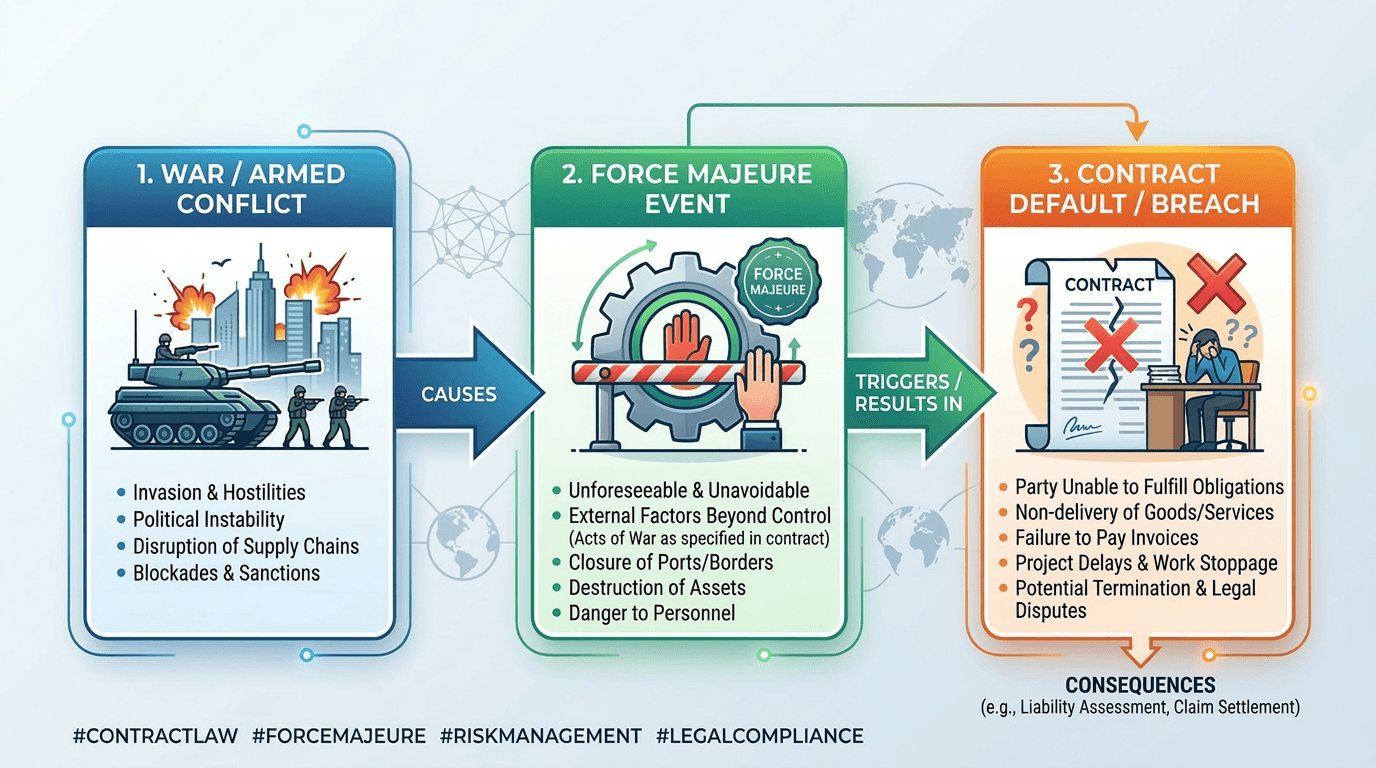
The past decade has been marked by a significant financial crisis, followed by the COVID-19 pandemic and an unlawful war initiated by a neighbouring nation. In the wake of these events, court practices have increasingly focused on the implications of unforeseen occurrences for the contractual obligations of the parties involved. Below is a concise summary of the key elements and conclusions drawn from a recently published digest by the Supreme Court. This overview may serve as a valuable guide for businesses to understand their rights arising from force majeure events.
1. General Criteria of Force Majeure
The Supreme Court has highlighted several mandatory characteristics of the force majeure events, which are:
- Independence from the will of the parties
- Extraordinary nature
- Unavoidability
- Objective impossibility of performing the obligation
Importantly, the mere fact of war, quarantine, or crisis does not automatically constitute force majeure — it is necessary to prove a causal link between the event and the impossibility of performing a specific obligation.
2. Force Majeure in Commercial Contracts
Key conclusions drawn from the recent cases highlight that:
- Lack of funds, licensing issues, or internal business difficulties do not constitute force majeure.
- If a contract contains specific force majeure provisions (notification deadlines, consequences, confirmation procedure), those provisions take priority.
- Force majeure releases a party from liability when it exists, but does not release it from the obligation to perform once the force majeure circumstances cease, unless otherwise provided by the contract.
- The parties may independently define in the contract:
- which events constitute force majeure;how they affect deadlines;whether they grant the right to terminate the contract.
In case such provisions exist, they shall be binding, and the court will accept them as valid grounds for excuse from liability.
3. Critical Elements of a Valid Claim: Notification of Force Majeure
It is very unfortunate when a relevant event occurs and can be shown to have rendered a contract unperformable, yet the claim is dismissed for formalities. Therefore, it is crucial to keep in mind:
- A party must immediately notify the counterparty of the occurrence of force majeure — this is a separate obligation, distinct from preserving or obtaining any other evidence, including a Chamber of Commerce and Industry (CCI) certificate.
- Late notification may deprive the party of the right to invoke force majeure, if this is stipulated in the contract.
- A CCI certificate or any other relevant evidence may be obtained later, but notification must be timely.
4. Evidence of Force Majeure
General rules of evidence apply regardless of any customary documents adduced in such cases. This is highlighted in a number of cases where the courts reinstate:
- No piece of evidence has an automatic, pre-established power in the court. The court evaluates all evidence together and in conjunction.
- It is necessary to prove a cause-and-effect relationship between the event and the impossibility of performing the obligation.
- Proof of timely notice to the other party is essential.
5. Typical Situations in Which the Supreme Court Has Drawn Conclusions
- COVID‑19 quarantine: does not automatically justify contract termination or exemption from liability — specific restrictions must be proven.
- Military aggression of the Russian Federation: is recognized as force majeure, but only if it is proven that it rendered performance of a specific contract impossible.
- Financial crisis of 2008: may have affected the ability to perform, but does not fully release parties from obligations.
- Destroyed property (e.g., Retroville shopping mall): may constitute force majeure, but a CCI letter alone is not sufficient evidence; additional proof is required.
6. Practical Consequences for the Parties of a Contract
The following key points briefly summarizing the court’s perspective on the impact of war and other unforeseen events on contractual obligations:
- Unless otherwise stated in the contract, force majeure does not cancel obligations, but rather suspends them or releases the party from penalties.
- If a party fails to comply with contractual notification requirements, it loses the right to invoke force majeure.
- A court may reduce penalties if their enforcement is disproportionate under the specific circumstances (e.g., during wartime).
For a complete overview of the Supreme Court's judicial practice regarding the application of force majeure as a basis for exemption from liability for breach of obligations, please refer to the document: Daigest_VS_fors_mazhor.pdf.
Should you require further assistance in drafting a specific force majeure clause or applying one to an existing dispute, please feel free to contact us for a consultation.
✒️By Olena Sadovets, Dual‑Qualified Advocate (Ukraine) & Solicitor (England & Wales)